
Contents
The Creative Mind of Friedensreich Hundertwasser
The Hundertwasser House in Vienna stands as a testament to the creative genius of Friedensreich Hundertwasser, an artist and architect known for his unconventional approach to design. Hundertwasser, born Friedrich Stowasser in 1928 in Vienna, was a multidisciplinary artist whose work extended beyond traditional boundaries. His name, “Friedensreich,” translates to “Peaceful Kingdom,” reflecting his commitment to harmony, both in nature and in art. Hundertwasser became recognized not only for his distinctive architectural style but also for his contributions to environmentalism and his philosophy regarding human interactions with the natural world.
Architectural Philosophy
Hundertwasser’s architectural philosophy was rooted in the belief that architecture should be in harmony with nature. He famously declared that linear, sterile environments had a negative impact on human well-being. As a reaction to what he termed the “Tyranny of the Straight Line,” Hundertwasser developed an organic style characterized by irregular forms, vibrant colors, and a distinctive use of natural elements. His architecture often includes undulating floors, irregular windows, and living roofs, all designed to make spaces more human-friendly and ecologically sustainable. Hundertwasser viewed rigidity and uniformity as constraints that limited creativity and disconnected individuals from their environment.
His designs were aimed at fostering a sense of unity and interconnectedness; he believed that architecture should be a reflection of the symbiotic relationship between humans and nature. Hundertwasser was an advocate for the integration of natural elements into building design, believing that it could alter the perception and use of urban spaces.
The Hundertwasser House Project
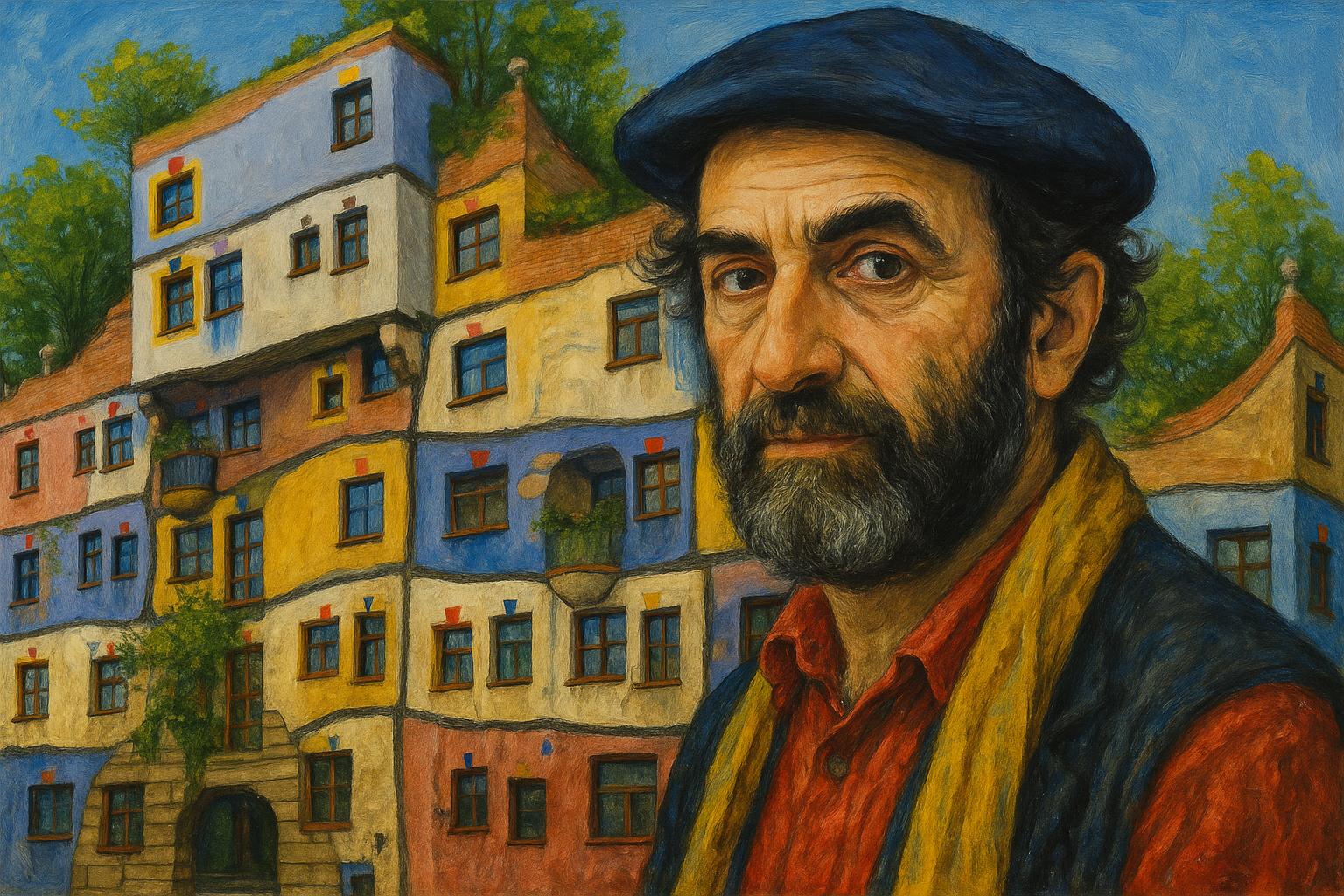
The Hundertwasser House, completed in 1985, serves as a seminal example of Hundertwasser’s architectural principles. This residential building, located in Vienna’s Landstraße district, was co-designed with architect Joseph Krawina. Hundertwasser’s unique vision transformed the building into a landmark that attracts tourists and architecture enthusiasts alike. The structure’s facade is a kaleidoscope of colors, punctuated with organic forms and vegetation, reflecting Hundertwasser’s commitment to the integration of natural and built environments.
The building is an embodiment of Hundertwasser’s philosophy, where nature finds its place amidst the man-made. The use of curvilinear forms and the inclusion of plant life throughout the building underscore Hundertwasser’s belief in architectural freedom and ecological awareness.
Innovative Design Elements
The Hundertwasser House features several innovative design elements that highlight Hundertwasser’s artistic talents and ecological considerations. These innovative elements are not mere aesthetic choices but align with deeper principles of design and environmental consciousness:
Irregular Windows: Each window in the building differs in size and shape, representing Hundertwasser’s belief in individualism and his disdain for uniformity. This irregularity breathes life into the building’s facade, giving it a playful and dynamic appearance. By defying the conventional grid system, Hundertwasser invites observers to question standardized architecture.
Living Roofs: The building’s terraces and rooftops are covered with soil and vegetation, promoting biodiversity and improving the microclimate. These green spaces are not only visually striking but serve practical functions. They help regulate temperatures, provide habitat for various species, and significantly reduce urban heat, thus fostering sustainability.
Undulating Floors: Hundertwasser incorporated uneven floors to discourage the sterile feeling of flat surfaces, making them resemble natural landscapes. This design choice engages occupants, offering a tactile and sensory experience that challenges the conformity of flat, monochrome surfaces typically found in modern buildings.
Legacy and Impact
Hundertwasser’s work continues to influence architects and artists who seek to create more sustainable and personal forms of architecture. The Hundertwasser House remains a prominent example of blending art with architectural practice and the potential for urban spaces to harmonize with the natural world. His legacy is not confined solely to architecture; it pervades an ethos of environmentalism and aesthetic innovation that encourages a broader reconsideration of how spaces are designed and inhabited.
His impact is evident in the ongoing dialogue about sustainable architecture, where designs aim to minimize ecological footprints while enhancing human experience. Hundertwasser’s approach calls for a reevaluation of architectural practices, urging a move towards buildings that nurture both their occupants and the environment.
The resonance of Hundertwasser’s ideas in today’s world is reflected in the work of numerous architects who continually explore the balance between aesthetic beauty and functional design. His visionary ideas preemptively engaged with contemporary concerns about sustainability and urbanization. This ongoing inspiration showcases his role as a pioneer, transforming his artistic convictions into practical output that continues to captivate and educate future generations.
Hundertwasser’s commitment to integrating art, ecology, and architecture illustrates the power of creative vision in addressing the challenges of human living spaces. As the importance of sustainable architecture grows in tandem with environmental awareness, Hundertwasser’s principles remain relevant and serve as a guiding light for those in pursuit of a more harmonious coexistence with our planet.